Social Icons

Pages

Showing posts with label Biological Facts. Show all posts

Monday, September 3, 2012

Hurray for the bees!!


Honey is one of the oldest food sources we know. This fascinating fluid is created by honey bees from the nectar of flowers. Let’s see what sciensational stuff we have for honey and the great honey bees.

Honey does not spoil.
Honeybees have remained unchanged in form or structure for 20 million years.


This is perhaps one of the greatest properties of honey. You could place it anywhere for thousands of years and it will not spoil. In fact, edible honey was found in ancient Egyptian Pharaoh King Tut’s tomb!
Honey contains large amounts of fructose and glucose. Naturally this makes it an ideal sweetener – much sweeter – almost 20 to 60 per cent more – than sugar itself!
You would think that such a sweet thing would be so bad for your health. Not so at all! Honey does not have any fats or cholesterol. It does not contain any sodium either. You could actually live off a just-honey diet because it is considered to be the only kind of food that has all necessary substances to sustain a normal human life, though it would be quite boring to have nothing but honey, eh?
A honey bee could visit around 2000 flowers in a day, flying around 25 kilometers per hour! That’s not all. It would take about 2 million flowers for these little creatures to visit to make just half a kilogram of honey! Not only that, just one single honey bee colony can produce between 30 to 40 kilograms of honey in a year.

Monday, August 20, 2012

Biological Adaptation

In biology, the term "adaptation" is known as the process by which a living thing becomes better suited to its environment. 
This biological adaptation may be of very kind: Structural Adaptations, Functional Adaptations, Color Adaptations and Behavioral Adaptations.
When biologists talk about this term they also use to relate it to the word Survival. There's also the expression "Survival of the Fittest", the explanation is that an environment tends to eliminate living things that are not suited to it. A plant that was not adapted to conserve moisture would soon die in the desert; an animal that stood out from its surroundings would be the most likely to fall prey to its enemies. This process of elimination is called natural selection. The phrase “survival of the fittest” refers to natural selection. Natural selection is an important factor in evolution.

An example of adaptation involving natural selection is found in the case of DDT and houseflies. When this insecticide was first used in the early 1940's, almost all the flies subjected to it were killed. Some, however, survived and continued to reproduce. Eventually only this type of resistant fly was left in the areas where DDT was used over a period of years.
Adaptation is not voluntary, but is based on inherited traits. The diversity of inherited traits is chiefly a result of mutation. Mutation is any change in the inherited characteristics of an organism which results in new traits that will be passed on to the organism's descendants. In any given environment, some traits will be advantageous and others will not. (In forests, the ability of an animal to climb trees might be an adaptation for survival, but on open grasslands speed would be more advantageous.) The organism that is best suited to its environment is most likely to survive and reproduce, and the traits that are not advantageous tend gradually to be eliminated.
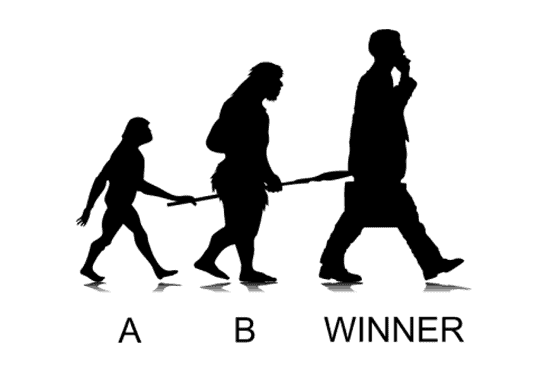
Well, in our case that's how we survived, by evolving:


Saturday, July 7, 2012

10 facts about human body


  • Here's a top list of some humand body facts:

  • 1 - Of the 206 bones in the human body, 1/4 are located in the feet.
  • 2 - The human heart has to pump blood back and forth through the 70,000 miles of blood vessels in the body once every minute.
  • 3 - The stomach has 35 million digestive glands.
  • 4 - Human hair is almost indestructible. It cannot be destroyed by cold, climactic changes, water or other natural forces (except fire). It also can survive exposure to many kinds of acids and corrosive chemicals.
  • 5 -There are 45 miles of nerves in the human body.
  • 6 - It is impossible for a person to keep their eyes open while sneezing.
  • 7 - Human eyes are capable of seeing more than 1 million simultaneous visual impressions and can distinguish between almost 8 million gradations of color.
  • 8 - The amount of pigment melanin in a person’s skin determines what color their skin will be. People with very little melanin have light colored skin, while people with large amounts of melanin have skin that is dark in color.
  • 9 - The human body consists of nine systems: the skeletal system  the muscular system, the nervous system, the hormonal system, the circulatory system, the digestive system, the respiratory system, the immune system and the reproductive system.
  • 10 - The human body has 10 trillion cells living within it.


  • Saturday, June 9, 2012

    Allelopathy


    The term allelopathy was created in 1937 by the investigator Hans Molisch to describe the way plants interact between them to understand the medium around them. The word results from the greek words allélon (mutual) and pathos (prejudice).

    Plants produce and release a great number of molecules resulting from their secundary metabolisms, that are released in the environment, affecting the plants around, their growth, their development and even the germination of some species.

    Monday, May 14, 2012

    Privacy Policy


    Privacy Policy for Video Production ( http://biological-facts.blogspot.com/)

    If you require any more information or have any questions about our privacy policy, please feel free to contact us by email at coolvideoproduction@hotmail.com. 
    At    http://biological-facts.blogspot.com/   , the privacy of our visitors is of extreme importance to us. This privacy policy document outlines the types of personal information is received and collected by   http://biological-facts.blogspot.com/     and how it is used.

    Log Files
    Like many other Web sites, http://biological-facts.blogspot.com/   makes use of log files. The information inside the log files includes internet protocol ( IP ) addresses, type of browser, Internet Service Provider ( ISP ), date/time stamp, referring/exit pages, and number of clicks to analyze trends, administer the site, track user’s movement around the site, and gather demographic information. IP addresses, and other such information are not linked to any information that is personally identifiable.

    Cookies and Web Beacons
    http://biological-facts.blogspot.com/  does not use cookies.

    DoubleClick DART Cookie
    .:: Google, as a third party vendor, uses cookies to serve ads on  http://biological-facts.blogspot.com/ .
    :: Google's use of the DART cookie enables it to serve ads to users based on their visit to   http://biological-facts.blogspot.com/    and other sites on the Internet. 
    .:: Users may opt out of the use of the DART cookie by visiting the Google ad and contentnetwork privacy policy at the following URL - http://www.google.com/privacy_ads.html

    Some of our advertising partners may use cookies and web beacons on our site. Our advertising partners include ....
    Google Adsense
    These third-party ad servers or ad networks use technology to the advertisements and links that appear on  http://biological-facts.blogspot.com/   send directly to your browsers. They automatically receive your IP address when this occurs. Other technologies ( such as cookies, JavaScript, or Web Beacons ) may also be used by the third-party ad networks to measure the effectiveness of their advertisements and / or to personalize the advertising content that you see.
    http://biological-facts.blogspot.com/   has no access to or control over these cookies that are used by third-party advertisers.
    You should consult the respective privacy policies of these third-party ad servers for more detailed information on their practices as well as for instructions about how to opt-out of certain practices.    http://biological-facts.blogspot.com/   's privacy policy does not apply to, and we cannot control the activities of, such other advertisers or web sites. 
    If you wish to disable cookies, you may do so through your individual browser options. More detailed information about cookie management with specific web browsers can be found at the browsers' respective websites.